Remote.co Survey Finds 62% of U.S. Workers Feel Financially Insecure in Their Current Job
Last Updated:
By
|

6 min read

As seen in:






Table of Contents

Explore remote jobs at leading companies across 100+ industries.
Financial Flexibility Report Names Top Industries for Part-Time Jobs, As 2 in 5 Workers Quit or Consider Quitting to Pursue Side Hustle Full-Time
Rising living costs, economic uncertainty, and ongoing layoffs are pushing many professionals to rethink how they achieve financial stability.
Remote.co’s 2026 Financial Flexibility Report examines how workers are responding to these pressures and the growing role side hustles play in modern career planning. Based on a survey of more than 4,000 U.S. professionals, the report found that the majority of workers don’t feel financially secure in their current job, helping explain why many professionals now see additional income streams as essential rather than optional.
Key Findings: Side Hustle Statistics in 2026
- 62% of U.S. workers say they feel financially insecure in their current job.
- 40% of professionals have quit or seriously considered quitting their job to pursue a side hustle full-time.
- Millennials lead in side hustle participation, with 30% currently working one.
- Gen X follows closely, with 26% reporting a side hustle.
- Boomers are the least likely to participate, with only 19% reporting current side hustle work.
- Customer service, administrative, healthcare, education, and computer & IT are among the top industries offering remote jobs as side hustle opportunities.
Financial Insecurity Is Driving Workers Toward Side Hustles
According to Remote.co’s 2026 Financial Flexibility Report, nearly two-thirds (62%) of workers say they don’t feel financially secure in their current role—only 38% report feeling financially stable.
So, how many people have side hustles? Remote.co’s survey shows the number continues to grow as professionals across generations actively build or pursue supplemental income streams. In fact, 2 in 5 professionals (40%) said they’ve quit or seriously considered quitting their job to pursue a side hustle full-time.
This steady trend over 2025 signals that the side gig economy is no longer viewed as supplemental, but as a strategic career choice by many workers.
What this means: Workers are increasingly turning to additional income streams as a response to financial uncertainty and economic pressures. These findings suggest that side hustles are shifting from optional extra work to a core career strategy for achieving financial stability.
Side Gigs by Generation: Millennials & Gen X Lead Side Hustle Work
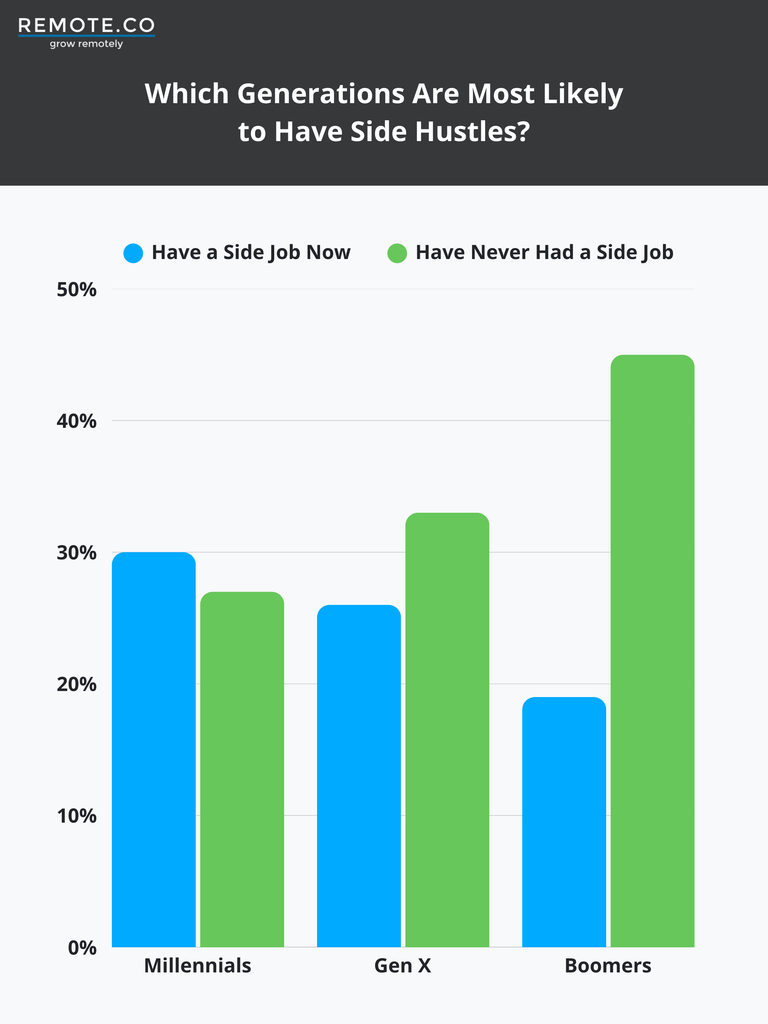
While interest spans generations, millennials and Gen X are driving the strongest momentum toward side jobs, as illustrated below:
- 30% of millennials currently have a side hustle, the highest of any generation.
- 26% of Gen X workers currently have one.
- Only 19% of boomers report currently having a side hustle.
Notably, boomers are also the least likely of the generations to have ever participated in side work, with 45% saying they’ve never had a side hustle, compared to 27% of millennials and 33% of Gen X who said the same.
Millennials and Gen X are also significantly more likely to consider leaving full-time employment for a side job:
- 34% of millennials have seriously considered quitting to pursue a side hustle full-time.
- 33% of Gen X report the same.
- Only 26% of boomers have seriously considered it.
Most workers, however, still prioritize financial security, requiring their side hustle to nearly match their current salary before they leave their jobs. In Remote.co’s report, the majority of workers wouldn’t quit their job unless a side hustle replaced at least half of their income, as shown below.
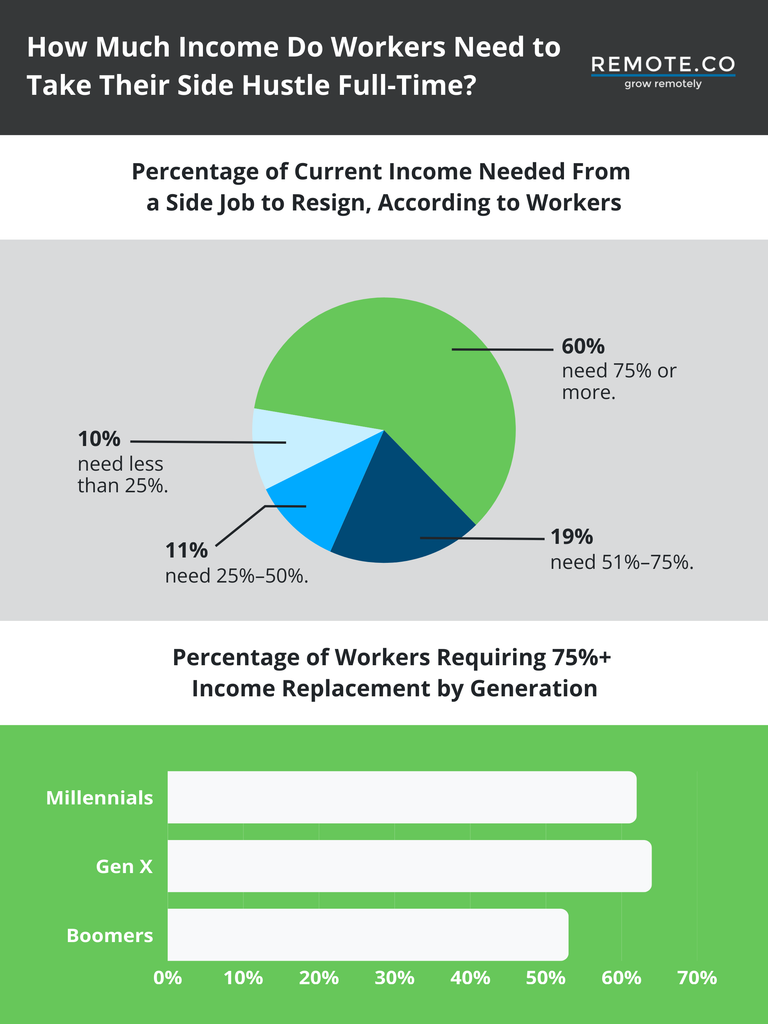
- 60% said the side job would need to cover 75% or more of their current income.
- 19% need it to replace 51%–75% of their current income.
- 11% would quit if their side gig replaced 25%–50% of their current income.
- Only 10% would quit if their side job covered less than 25% of their current income.
Similarly, among generations, the majority of millennials (62%), Gen X (64%), and boomers (53%) said their side hustle would need to replace at least 75% of their income before they’d resign.
What this means: Millennials and Gen X are leading the movement toward side hustles as a serious career path rather than a temporary side project. At the same time, workers across generations remain cautious about leaving traditional employment, underscoring how strongly financial stability still shapes major career moves.

Join Remote.co to Unlock & Apply to Remote Jobs

Side Hustle Economy: Top 10 Fields for Part-Time Work-From-Home Jobs
To help workers identify the in-demand industries for flexible side hustles, Remote.co analyzed freelance, temporary, and part-time remote job postings in its database between March 1, 2025, and March 1, 2026.
Reflecting the employer demand for flexible, remote talent, particularly in roles that support digital operations, the leading industries with the most remote side jobs include:
The rise of side hustles reflects a broader shift in how workers approach financial security and career stability in 2026. As economic uncertainty and rising costs continue to affect the workforce, more professionals are turning to multiple income streams to strengthen their financial footing.
These findings highlight how polyworking is becoming an increasingly common strategy for navigating today’s evolving job market.
For press inquiries, please contact Shanna Briggs, public relations manager, at shanna.briggs@bold.com.
Methodology
The 2026 Financial Flexibility Report surveyed more than 4,000 U.S. professionals between February 2, 2026, and February 16, 2026, examining financial confidence, employment decisions, and attitudes toward side work amid ongoing economic shifts. The sample included respondents across a range of age groups, genders, education, and career levels.
About Remote.co
Remote.co‘s remote jobs board is the go-to resource for remote work and remote career information. In addition to verified remote job listings, Remote.co provides in-depth articles, Q&As, and actionable resources to help professionals maximize the benefits of remote jobs and navigate the evolving world of remote work. Featured in publications such as Forbes magazine, BuzzFeed, The New York Times Wirecutter, and more, Remote.co has established itself as a trusted platform for remote jobs and career advice. Follow Remote.co on Facebook, X, and LinkedIn for the latest trends, insights, and opportunities in remote work.

WRITTEN BY
See more articles from


Join Remote.co to Begin Exploring Remote Jobs
Remote Work Articles

NEW!
Remote Medical Coding Jobs: 10 Companies Hiring
Looking for remote medical coding jobs? Explore 10 companies hiring remote medical coders, such as Banner Health and UnitedHealth…
Read More : Remote Medical Coding Jobs: 10 Companies Hiring
NEW!
Remote Admin Jobs: 10 Companies Hiring
Discover remote admin jobs with 10 companies hiring now, including Aquent Talent and NeoWork. Find work-from-home jobs in administrative…
Read More: Remote Admin Jobs: 10 Companies Hiring
NEW!
Remote Health Coach Jobs: 10 Companies Hiring
Discover remote health coach jobs with 10 companies hiring now, like Blueprint Health and Revero. Find work-from-home jobs in…
Read More: Remote Health Coach Jobs: 10 Companies Hiring